
Method demo
Decoding OmaStadi service
When a complex service needs to change, the service reality is often scattered across teams, systems and documents. This demonstration shows what can be learned from a quick scan of public evidence.
OmaStadi is the City of Helsinki’s participatory budgeting service, through which residents propose and vote on improvements to their neighbourhoods.
It was chosen as a test case because it combines a complex service, public code and a rich public evidence footprint.
This independent work is not commissioned by or produced with the City of Helsinki.
/decode is Kunity’s AI-powered method for turning scattered evidence into shared understanding across service, operations, and technology. It helps teams manage, change, design, and modernize complex services.
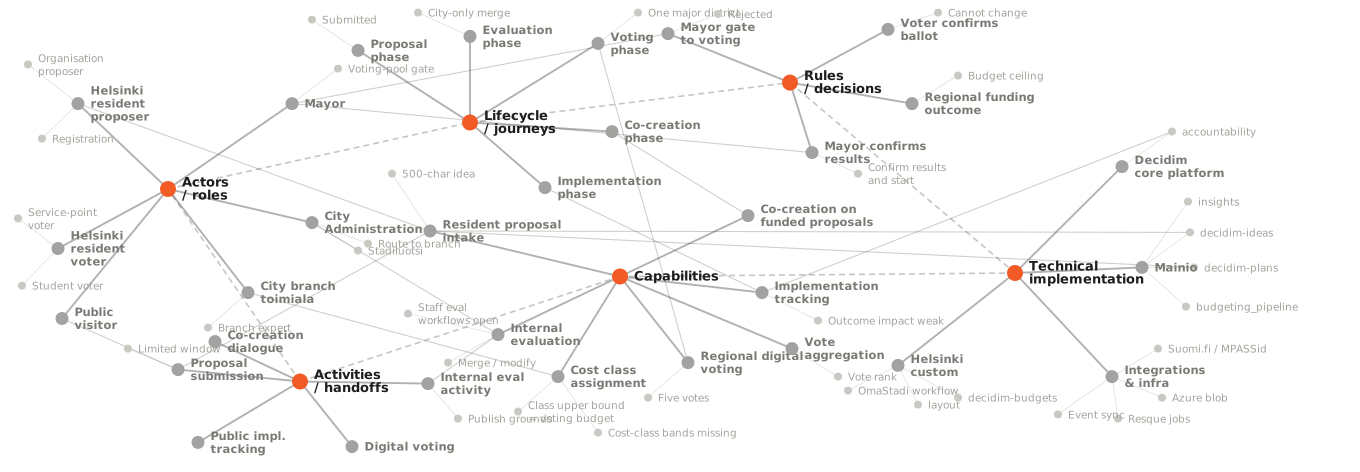
/decode first gathers a source inventory, then extracts and reconciles evidence, and finally consolidates the service reality into a structured service model.
From evidence to service model
decoded evidence
- 32 Codebase sources
- 15 Live captures
- 14 Public pages
- 8 Public documents
Service model
- 175 Verified claims
- 14 Capabilities
- 13 Actors
- 18 Questions & conflicts
- 3 Journeys
One model, many connected views
The structured service model holds the shared understanding and provides a common foundation for decisions. Different views and artifacts can be created from it and kept aligned as new evidence emerges.
Try the four journey segment buttons to explore linked view examples.
| Preparation | Submission | Evaluation | Selection | Voting | Results | Co-creation | Imple- |
|
|---|---|---|---|---|---|---|---|---|
| Resident |
|
|
|
|
|
|
|
|
| Frontstage |
|
|
|
|
|
|
|
|
| Backstage |
|
|
|
|
|
|
|
|
Shared context for humans and AI
The same model can be queried by people and AI.
Because the information is already structured, AI can pull just the relevant parts instead of scanning a large text corpus - often improving precision and reducing token use.
Every insight can be tracked back to the source.
Conclusion
A quick scan of public evidence produced a surprisingly rich picture of OmaStadi before any human-centered research.
The resulting service model connects journeys, actors, capabilities, technical implementation, and supporting evidence in a shared, traceable structure.
It also preserves contradictions, unknowns, and evidence gaps rather than presenting an artificially complete understanding.
The follow-up research could be directed towards the questions where human insight is most needed.
In short, /decode helped build an understanding of the service quickly.
The structured service model would remain at the core of the next steps - focused research, opportunity identification, and solution exploration.
It keeps decisions traceable, and prevents important details from getting lost in translation.
Do you have a service that you would like to understand, change or modernize?
Let’s discuss.